Buy badiacalavena.eu ?
We are moving the project
badiacalavena.eu .
Are you interested in purchasing the domain
badiacalavena.eu ?
domain@kv-gmbh.de · 0541-91531010
Buy badiacalavena.eu ?
What are planetary phases?
Planetary phases refer to the different appearances of a planet as seen from Earth as it orbits the Sun. These phases are caused by the changing relative positions of the Sun, the planet, and the Earth. For example, Venus and Mercury exhibit phases similar to the Moon, with crescent, gibbous, and full phases. The inner planets, Mercury and Venus, can exhibit all phases, while the outer planets, such as Mars, Jupiter, and Saturn, exhibit only crescent and gibbous phases. **
Can planetary orbits intersect?
No, planetary orbits cannot intersect. In our solar system, each planet orbits the sun in its own distinct path, and these paths do not cross or intersect. This is due to the gravitational forces between the planets and the sun, which keep their orbits separate and stable. If planetary orbits were to intersect, it would lead to chaotic and unstable interactions between the planets, which is not observed in our solar system. **


Similar search terms for Planetary
Top-Angebote
Products related to Planetary:
-
Is Naruto on a planetary level?
Naruto is not considered to be on a planetary level in terms of power. While he possesses immense strength, speed, and abilities, his powers are typically portrayed as being more focused on a smaller scale, such as battles between individuals or smaller groups. Characters who are considered to be on a planetary level are usually capable of destroying or affecting entire planets with their powers, which is not a feat commonly associated with Naruto. **
-
How quickly do planetary stars explode?
Planetary stars, also known as brown dwarfs, do not actually explode. They are failed stars that do not have enough mass to sustain nuclear fusion in their cores. Instead, they slowly cool and fade over billions of years. As they cool, they may eventually become "black dwarfs," which are essentially cold, dead remnants of once-energetic stars. So, rather than exploding, planetary stars have a much slower and more gradual end to their existence. **
-
What is a tractor planetary gearbox?
A tractor planetary gearbox is a type of transmission system used in tractors and other heavy machinery. It consists of a set of gears arranged in a planetary gear system, which allows for different gear ratios and torque multiplication. This type of gearbox is commonly used in tractors to provide the necessary power and speed for various agricultural tasks such as plowing, tilling, and hauling. The planetary gearbox is designed to handle the high torque and heavy loads typically encountered in agricultural applications. **
-
What kind of planetary year is 2020?
2020 is a leap year, which means it has 366 days instead of the usual 365 days. Leap years occur every four years to account for the extra time it takes for the Earth to orbit the sun. This extra day is added in February as February 29th. **

Why is our planetary system disk-shaped?
Our planetary system is disk-shaped because it formed from a spinning, flattened cloud of gas and dust known as the solar nebula. As the cloud collapsed under its own gravity, it began to spin faster, causing it to flatten into a disk shape due to conservation of angular momentum. Within this disk, particles collided and stuck together, eventually forming the planets, moons, and other objects in our solar system. This disk shape is a common feature of planetary systems, as seen in other star systems as well. **
In which direction do the planetary orbits run?
The planetary orbits run counterclockwise around the Sun when viewed from above the Earth's North Pole. This means that the planets move in the same direction as the Sun's rotation. This counterclockwise motion is known as prograde motion. The planets all orbit the Sun in roughly the same plane, known as the ecliptic plane. **
Top-Angebote
Products related to Planetary:
-
What are planetary phases?
Planetary phases refer to the different appearances of a planet as seen from Earth as it orbits the Sun. These phases are caused by the changing relative positions of the Sun, the planet, and the Earth. For example, Venus and Mercury exhibit phases similar to the Moon, with crescent, gibbous, and full phases. The inner planets, Mercury and Venus, can exhibit all phases, while the outer planets, such as Mars, Jupiter, and Saturn, exhibit only crescent and gibbous phases. **
-
Can planetary orbits intersect?
No, planetary orbits cannot intersect. In our solar system, each planet orbits the sun in its own distinct path, and these paths do not cross or intersect. This is due to the gravitational forces between the planets and the sun, which keep their orbits separate and stable. If planetary orbits were to intersect, it would lead to chaotic and unstable interactions between the planets, which is not observed in our solar system. **
-
Is Naruto on a planetary level?
Naruto is not considered to be on a planetary level in terms of power. While he possesses immense strength, speed, and abilities, his powers are typically portrayed as being more focused on a smaller scale, such as battles between individuals or smaller groups. Characters who are considered to be on a planetary level are usually capable of destroying or affecting entire planets with their powers, which is not a feat commonly associated with Naruto. **
-
How quickly do planetary stars explode?
Planetary stars, also known as brown dwarfs, do not actually explode. They are failed stars that do not have enough mass to sustain nuclear fusion in their cores. Instead, they slowly cool and fade over billions of years. As they cool, they may eventually become "black dwarfs," which are essentially cold, dead remnants of once-energetic stars. So, rather than exploding, planetary stars have a much slower and more gradual end to their existence. **
Similar search terms for Planetary
-
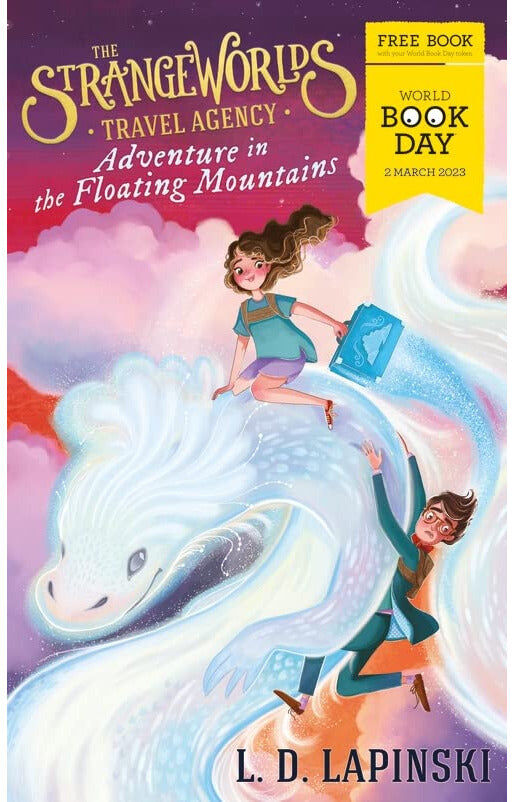
Orion Strangeworlds Travel Agency: Adventure in the Floating Mountains by L.D. Lapinski – World Book Day AdventureIt is the once-every-century Cloud-Wish Festival in the magical world of Strofadia, and Flick and Jonathan have travelled via suitcase to be a part of it.Strofadia is a land of flight and fantasy, where the people are born with wings and the great floating mountains are seen as the source of fantastic power. There are three floating mountains, with the largest being known as the home of the great Cloud Dragon - keeper of magic and granter of wishes. The people of Strofadia take their magical wishes (in the form of a physical bead-like object) to the dragon, in the hopes that the wish will be granted at the end of the festival when the dragon appears.Flick and Jonathan have fun exploring Strofadia, but when the moons rise, there is no sign of movement from the mountain.Will Flick and Jonathan be able to find out what happened to the dragon and save the festival and the land of Strofadia from disaster?A 2023 World Book Day Title0,99 £*Shipping: 1,99 £Secure redirect to the provider
-
Uplifted Trends Foldable Silicone Travel Cup With Lid Compact Portable & Durable Water Cup For Camping Travel & Outdoors yellowWhether youre heading on a camping trip, hiking adventure, or a quick getaway, this foldable silicone travel cup 180 ML is the perfect companion. Crafted from durable, highquality silicone, it collapses for easy storage and includes a secure lid to...34,97 $*Shipping: 0,00 $Secure redirect to the provider
-
What is a tractor planetary gearbox?
A tractor planetary gearbox is a type of transmission system used in tractors and other heavy machinery. It consists of a set of gears arranged in a planetary gear system, which allows for different gear ratios and torque multiplication. This type of gearbox is commonly used in tractors to provide the necessary power and speed for various agricultural tasks such as plowing, tilling, and hauling. The planetary gearbox is designed to handle the high torque and heavy loads typically encountered in agricultural applications. **
-
What kind of planetary year is 2020?
2020 is a leap year, which means it has 366 days instead of the usual 365 days. Leap years occur every four years to account for the extra time it takes for the Earth to orbit the sun. This extra day is added in February as February 29th. **
-
Why is our planetary system disk-shaped?
Our planetary system is disk-shaped because it formed from a spinning, flattened cloud of gas and dust known as the solar nebula. As the cloud collapsed under its own gravity, it began to spin faster, causing it to flatten into a disk shape due to conservation of angular momentum. Within this disk, particles collided and stuck together, eventually forming the planets, moons, and other objects in our solar system. This disk shape is a common feature of planetary systems, as seen in other star systems as well. **
-
In which direction do the planetary orbits run?
The planetary orbits run counterclockwise around the Sun when viewed from above the Earth's North Pole. This means that the planets move in the same direction as the Sun's rotation. This counterclockwise motion is known as prograde motion. The planets all orbit the Sun in roughly the same plane, known as the ecliptic plane. **
* All prices are inclusive of VAT and, if applicable, plus shipping costs. The offer information is based on the details provided by the respective shop and is updated through automated processes. Real-time updates do not occur, so deviations can occur in individual cases. ** Note: Parts of this content were created by AI.